
Connecticut sits on key freight corridors including I-95, I-84, and I-91. Commercial traffic volume on these routes is significant, and enforcement resources are concentrated along these corridors. Carriers operating through Connecticut should expect to encounter inspection stations and enforcement operations. Connecticut State Police (CSP) and Connecticut Department of Transportation (ConnDOT) conduct inspections at weigh stations and on state highways. Miss a requirement and you face citations, Out-of-Service orders, or enforcement action that compounds across your entire operation.
This guide covers everything Connecticut carriers need to know about DOT vehicle inspections, federal registration requirements, how California’s BIT program may apply to your operations, compliance strategies, and avoiding violations that can sideline your trucks.
🎯 At a Glance: Connecticut DOT Compliance
- DOT (Annual Vehicle Inspection): Verifies mechanical safety of individual trucks and trailers. Required annually for all commercial vehicles over 10,001 lbs GVWR operating in Connecticut.
- Roadside Inspections: CSP conducts unannounced inspections at weigh stations along I-95, I-84, and I-91, plus roving highway patrols. Any violation can result in immediate Out-of-Service orders.
- Federal Registration: USDOT number required for interstate operations. Intrastate carriers operating vehicles over 26,001 lbs GVWR also need USDOT registration. Section 2 for details ↓.
- California BIT Awareness: If your Connecticut fleet regularly operates commercial vehicles in California or maintains a terminal there, California’s BIT program may apply to you. Section 3 for details ↓.
Your complete guide to Connecticut DOT compliance
- 1Understanding DOT Inspections in Connecticut
- 2Motor Carrier Permits & Federal Registration
- 3How California’s BIT Program May Apply to Connecticut Carriers
- 4The 7 DOT Inspection Levels Explained
- 5Inspection Checklists: What Gets Inspected
- 6Technician Training and Inspector Qualifications
- 7Record Retention: What to Keep and How Long
Connecticut DOT Foundations
SECTION 1 OF 17
Understanding DOT Inspections in Connecticut
The foundation: how Connecticut enforces federal DOT regulations and what that means for your fleet operations.
Connecticut operates under federal DOT regulations for commercial vehicle safety. The Connecticut State Police (CSP) conducts roadside inspections at weigh stations and on state highways. Connecticut DMV handles commercial vehicle registration, IRP, and IFTA. Fail to comply with either track and you’re facing Out-of-Service orders, fines, and safety rating damage that follows your carrier profile.
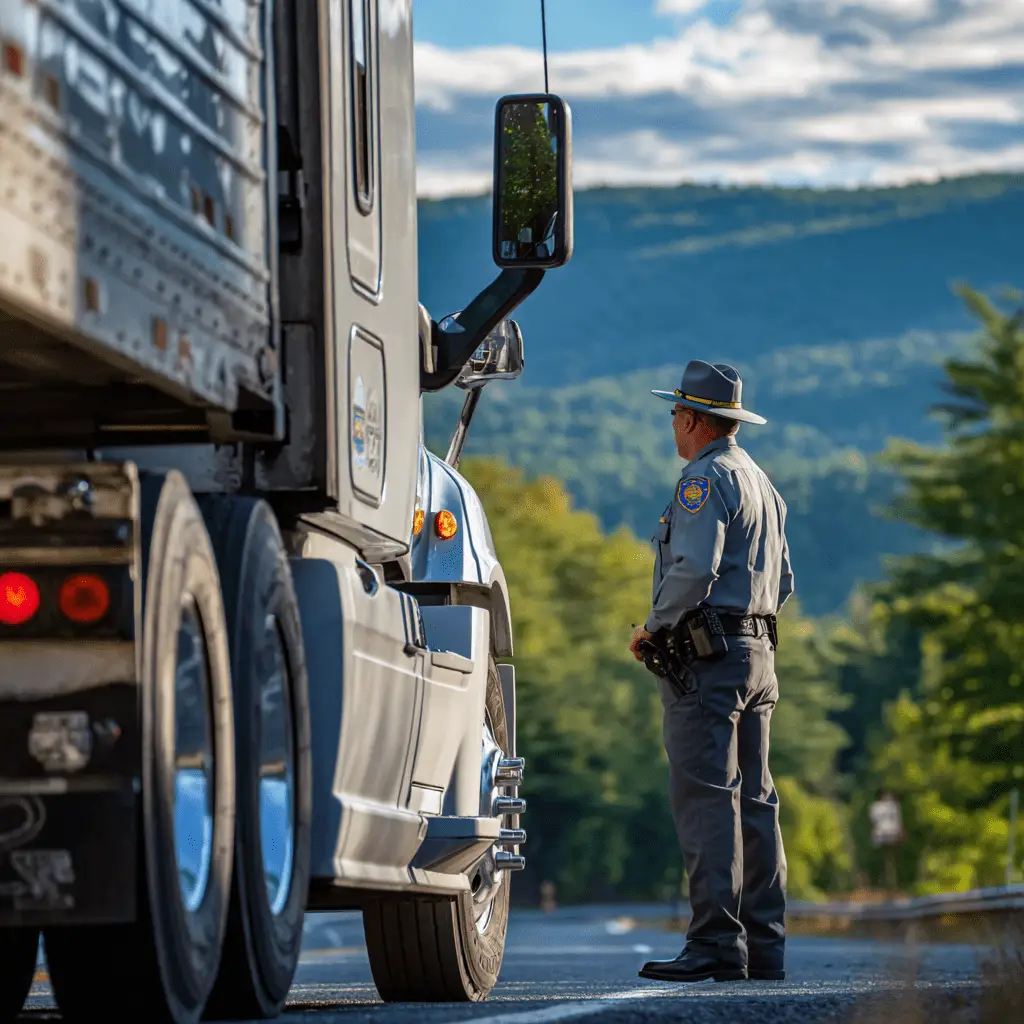
According to 49 CFR 396.17, federal DOT regulations require annual vehicle inspections for commercial motor vehicles over 10,001 pounds GVWR. Connecticut enforces these requirements through its CSP Commercial Vehicle Enforcement Bureau and CSP Commercial Vehicle Unit. Officers conduct inspections at Connecticut’s weigh stations along major interstate corridors including I-95, I-84, I-91, and perform roving patrols on state highways. Any violation can result in immediate Out-of-Service orders that ground your vehicle until repairs are completed.
What are DOT Inspections?
DOT inspections verify the mechanical safety of commercial motor vehicles. Inspectors check brake systems, tires, lights, coupling devices, and other safety components. They also verify driver credentials including CDL status, medical certification, hours of service compliance, and hazmat endorsements where applicable.
CSP and CSP CVE use the Commercial Vehicle Safety Alliance (CVSA) North American Standard inspection procedures. These standardized protocols ensure consistent enforcement across all states and Canadian provinces. An inspection in Connecticut follows the same criteria as one in California, Texas, or anywhere else in North America.
Commercial vehicles subject to inspection include:
- Trucks and tractors with a GVWR over 10,001 lbs
- Trailers with a GVWR over 10,001 lbs
- Vehicles transporting hazardous materials requiring placards
- Vehicles designed to transport 16+ passengers (regardless of compensation) or 9+ passengers when used for compensation
- Any commercial motor vehicle operating in interstate commerce
Connecticut’s Enforcement Agencies
Understanding who enforces what in Connecticut helps you prepare for inspections and know which agency to contact for specific issues.
Connecticut State Police (CSP)
Primary enforcement agency for commercial vehicle safety. CSP operates the Commercial Vehicle Enforcement Bureau, conducting roadside inspections, roving highway patrols, and targeted enforcement operations. CSP officers have authority to issue citations, place vehicles Out-of-Service, and conduct carrier safety audits. The CSP Commercial Vehicle Enforcement Task Force now includes ConnDOT enforcement officers under a unified management structure.
Connecticut Connecticut Department of Transportation (ConnDOT)
Handles commercial vehicle registration, permitting, and credentials through the Department of Motor Vehicles. CSP Commercial Vehicle Unit (CSP CVE) staffs weigh stations, manages oversize/overweight permits, and operates the New Entrant Motor Carrier Safety Program. CT DMV manages IRP (International Registration Plan), IFTA (International Fuel Tax Agreement), and commercial vehicle permits.
Connecticut DMV
Manages intrastate operating authority, commercial vehicle registration, and permitting for carriers operating within Connecticut. If you operate commercial vehicles solely within Connecticut, contact CT DMV to confirm you have the correct operating authority under your company’s profile.
Federal Agencies in Connecticut
FMCSA (Federal Motor Carrier Safety Administration): Sets federal regulations, conducts compliance reviews, and maintains the national safety database. FMCSA investigators work with CSP on major enforcement actions.
CVSA (Commercial Vehicle Safety Alliance): While not a government agency, CVSA sets the inspection standards that Connecticut and all other states follow. CVSA coordinates the annual International Roadcheck, including the Connecticut Motor Carrier Safety Assistance Program enforcement details on I-95 and I-84.
Connecticut’s Ports of Entry
Connecticut operates commercial vehicle weigh stations at its interstate and international borders. These fixed inspection sites monitor all commercial traffic entering Connecticut for registration, taxes, size and weight restrictions, CDL requirements, and insurance compliance.
Port of entry locations include facilities along:
- I-95: near the New York border at Greenwich and near the Rhode Island border at Pawcatuck
- I-84: near the New York border at Danbury
- I-91: near the Massachusetts border at Enfield
Connecticut uses weigh-in-motion technology and electronic screening systems (PrePass and Drivewyze) at these locations. Carriers enrolled in these programs with clean safety records can often bypass the scale, while flagged carriers are directed in for inspection.
What Triggers an Inspection?
Connecticut doesn’t publish specific formulas for inspection frequency, but several factors increase your likelihood of being stopped:
- Safety rating: Carriers with Conditional or Unsatisfactory ratings face increased scrutiny
- ISS score: FMCSA’s Inspection Selection System flags high-risk carriers at weigh stations
- Vehicle condition: Visible defects (flat tires, damaged lights, fluid leaks) attract attention
- Past violations: History of serious violations increases inspection probability
- Complaint history: Complaints filed through FMCSA’s National Consumer Complaint Database trigger targeted enforcement
- Random selection: Even clean carriers get selected for random inspections
⚠️ Connecticut’s Geographic Reality
Connecticut sits on key freight corridors including I-95, I-84, and I-91. Commercial traffic volume on these routes is significant, and enforcement resources are concentrated along these corridors. Carriers operating through Connecticut should expect to encounter inspection stations and enforcement operations.
Permits, Registration & Federal Requirements
SECTION 2 OF 17
Motor Carrier Permits & Federal Registration
The permits, registrations, and federal filings required before you can legally operate commercial vehicles in Connecticut.
Before your trucks hit Connecticut highways, you need proper authority and registration. The requirements vary based on whether you operate interstate (crossing state lines) or intrastate (within Connecticut only), and what type of cargo or passengers you carry. Missing any required credential creates immediate enforcement exposure at any Connecticut weigh station or roadside inspection.
This section covers every permit and registration Connecticut commercial carriers need, from federal USDOT numbers to state-level registrations, interstate agreements, and ongoing filing requirements.
USDOT Number Requirements
The USDOT number is the foundation of federal motor carrier registration. Every interstate motor carrier must have one. Connecticut also requires USDOT numbers for many intrastate operations.
You need a USDOT number if you operate:
- Vehicles over 10,001 lbs GVWR in interstate commerce
- Vehicles designed to transport 9+ passengers for compensation crossing state lines
- Vehicles designed to transport 16+ passengers (regardless of compensation)
- Any vehicle transporting hazardous materials requiring placards
- Intrastate commercial vehicles over 26,001 lbs GVWR operating in Connecticut (per Conn. Gen. Stat. § 14-163c)
🏛️ USDOT Registration
Apply at FMCSA Unified Registration System. The application is free. USDOT numbers are issued instantly online, though full registration processing for first-time applicants takes 20-25 business days. Your USDOT number must be displayed on both sides of your power units per 49 CFR 390.21.
✅ Already have your permits?
Registration process:
- Apply through the FMCSA Unified Registration System
- The application is free
- USDOT numbers are issued instantly online
- Full registration processing for first-time applicants takes 20-25 business days
Display requirements: USDOT number and legal company name must be displayed on both sides of the power unit in letters at least 2 inches high, in a color that contrasts with the background.
Click any section below to expand:
MCS-150 Biennial Update
Every motor carrier must update their MCS-150 form (Motor Carrier Identification Report) every two years based on the last digit of their USDOT number. Failing to update on time places your USDOT number in “Not Authorized” status, which can trigger enforcement action at any Connecticut weigh station.
Update schedule by last digit of USDOT number:
- 1 — January
- 2 — February
- 3 — March
- 4 — April
- 5 — May
- 6 — June
- 7 — July
- 8 — August
- 9 — September
- 0 — October
Update online at FMCSA Registration
MC Number (Operating Authority)
If you haul freight or passengers for compensation across state lines, you need MC (Motor Carrier) authority from FMCSA in addition to your USDOT number. The USDOT number identifies you. The MC number authorizes you to operate.
Who needs MC authority:
- For-hire carriers transporting regulated commodities in interstate commerce
- Freight brokers arranging transportation of regulated commodities
- Freight forwarders
- Passenger carriers operating across state lines
Who does NOT need MC authority:
- Private carriers hauling their own goods
- Carriers exclusively hauling exempt commodities (most agricultural products, newspapers)
- Carriers operating exclusively within Connecticut (intrastate only)
Apply through the FMCSA Unified Registration System. Processing takes 20-25 business days. You must also file proof of insurance (Form BMC-91 or BMC-91X) and a process agent designation (Form BOC-3).
BOC-3 Process Agent Designation
Every interstate motor carrier must file a BOC-3 form designating a process agent in each state where you operate. The process agent is the legal contact who can accept court papers and legal documents on your behalf.
You must have a process agent in every state you operate through, including states you only pass through. Several companies offer blanket BOC-3 service covering all 50 states for an annual fee. File through the FMCSA Registration System.
UCR (Unified Carrier Registration)
UCR is a federally-mandated annual registration and fee program for interstate motor carriers, brokers, freight forwarders, and leasing companies. The fees fund state motor carrier safety programs and enforcement.
Who must register:
- Interstate for-hire and private motor carriers
- Brokers
- Freight forwarders
- Leasing companies
Fees are based on fleet size (number of vehicles, including trailers). Registration must be renewed annually. Register at UCR.gov
Failure to register can result in fines at Connecticut weigh stations. Officers routinely check UCR status during inspections.
IRP (International Registration Plan)
IRP is a registration reciprocity agreement among U.S. states, the District of Columbia, and Canadian provinces. It provides apportioned registration for commercial vehicles operating across multiple jurisdictions.
Who needs IRP registration:
- Power units (trucks and tractors) used in interstate or international commerce
- Vehicles exceeding 26,000 lbs GVWR or having 3+ axles regardless of weight
- Vehicles used in the transportation of persons for hire
Connecticut’s IRP is administered by Connecticut Division of Motor Vehicles (DMV). Apply through CT DMV: IRP Registration
IRP cab cards must be carried in the vehicle at all times. Officers at Connecticut weigh stations verify IRP registration as part of routine screening.
IFTA (International Fuel Tax Agreement)
IFTA simplifies fuel tax reporting for carriers operating across multiple states and provinces. Instead of buying fuel permits for each state, you report all fuel purchases and miles traveled quarterly, and taxes are distributed to each jurisdiction.
Who needs IFTA:
- Qualified motor vehicles (over 26,000 lbs GVWR or having 3+ axles) traveling in two or more IFTA jurisdictions
Connecticut’s IFTA is administered by Connecticut Department of Revenue Services (DRS). Apply through CT DRS: IFTA Registration
IFTA decals must be displayed on both sides of the cab exterior. Quarterly tax returns are due the last day of the month following each quarter (April 30, July 31, October 31, January 31).
Connecticut Intrastate Operating Authority (ConnDOT)
If you haul freight or passengers for compensation exclusively within Connecticut (intrastate for-hire), you need to ensure you have the correct operating authority registered with the appropriate Connecticut state agency.
Connecticut manages intrastate motor carrier authority through its transportation regulatory body. Contact CT DMV: Motor Carrier Services for current requirements.
Note: Private carriers (hauling your own goods) use the same registration process. Interstate carriers obtain authority through FMCSA.
Insurance Requirements
Federal insurance minimums for interstate carriers depend on what you haul:
- General freight (non-hazmat): $750,000 minimum liability for vehicles over 10,001 lbs GVWR
- Household goods: $750,000 minimum liability
- Oil (hazmat): $1,000,000 minimum liability
- Other hazmat: $5,000,000 minimum liability
- Passengers (16+ capacity): $5,000,000 minimum liability
- Passengers (under 16 capacity): $1,500,000 minimum liability
Proof of insurance must be filed with FMCSA (Form BMC-91 or BMC-91X). Lapse in coverage can result in your operating authority being revoked. Connecticut intrastate requirements are managed through the state regulatory agency and may differ from federal minimums.
Entry-Level Driver Training (ELDT)
Since February 7, 2022, first-time CDL applicants must complete Entry-Level Driver Training from an FMCSA-registered provider before taking CDL skills tests. This requirement applies to:
- First-time Class A or Class B CDL applicants
- Drivers upgrading from Class B to Class A CDL
- First-time hazardous materials (H), passenger (P), or school bus (S) endorsement applicants
How it works: Training providers submit completion certificates to FMCSA’s Training Provider Registry (TPR). The Connecticut Motor Vehicle Division verifies TPR certification before administering your skills test. No TPR record means no skills test.
Who is exempt: Drivers who held a CDL before February 7, 2022 are grandfathered. Drivers with a CLP issued before that date who obtained their CDL before the CLP expired are also exempt.
Find registered training providers and verify completion status at FMCSA Training Provider Registry
FMCSA Drug & Alcohol Clearinghouse
Since January 2020, employers must use the FMCSA Drug & Alcohol Clearinghouse to check driver violation histories. This applies to all CDL drivers subject to USDOT drug and alcohol testing.
Employer requirements:
- Pre-employment query: Required before hiring any CDL driver
- Annual query: Required for all current CDL drivers at least once per year
- Report violations: Employers must report positive tests, refusals, and actual knowledge of drug/alcohol use within 3 business days
November 2024 change: State Driver Licensing Agencies (including Connecticut DMV) must now query the Clearinghouse before issuing, renewing, or upgrading CDLs. Drivers with unresolved violations cannot obtain or renew their CDL.
Driver consent: Drivers must provide electronic consent before employers can run queries. Limited queries (which show only whether violations exist) require general consent. Full queries (showing violation details) require specific consent for each query.
Return-to-duty process: Drivers with violations must complete a return-to-duty process with a Substance Abuse Professional (SAP) before returning to safety-sensitive functions. This information remains in the Clearinghouse for 5 years.
Employers and drivers register at FMCSA Drug & Alcohol Clearinghouse
HAZMAT Requirements
Carriers transporting hazardous materials requiring placards have additional requirements beyond standard DOT registration:
- HAZMAT Safety Permit: Required from FMCSA for certain high-risk materials (radioactive, explosives, poison inhalation, compressed/liquefied gases in bulk)
- Security Plan: Written security plan required under 49 CFR 172.800 for carriers offering hazmat transportation
- Driver Endorsements: CDL with hazmat endorsement (H) requires TSA background check
- Vehicle Placarding: Proper placards must be displayed per 49 CFR 172
HAZMAT registration through FMCSA Registration
CDL Requirements
Federal CDL requirements apply in Connecticut through the Connecticut Motor Vehicle Division:
- Class A: Combination vehicles with GCWR over 26,001 lbs (when towed vehicle is over 10,001 lbs)
- Class B: Single vehicles with GVWR over 26,001 lbs
- Class C: Vehicles transporting hazmat or 16+ passengers that don’t meet Class A or B thresholds
Endorsements:
- H — Hazmat (requires TSA background check)
- N — Tank vehicles
- P — Passenger
- S — School bus
- T — Doubles/triples
- X — Combination of hazmat and tank
Connecticut CDL applications and renewals through CT DMV: Commercial Driver Licensing
Oversize/Overweight Permits
Vehicles or loads exceeding Connecticut’s legal size and weight limits require special permits from ConnDOT.
Standard Connecticut limits:
- 80,000 lbs gross vehicle weight | 22,400 lbs single axle | 36,000 lbs tandem axle | 8.5 feet width | 13.5 feet height | 65 feet overall length
Apply for permits through ConnDOT: Oversize/Overweight Permits
Weigh Station Bypass Programs
Carriers with strong safety records can qualify for weigh station bypass programs, reducing inspection delays and improving operational efficiency.
PrePass: Uses transponders and screening technology at 900+ weigh stations nationwide. Vehicles with good safety records receive green light signals to bypass stations. Enrollment requires clean CSA scores and current registrations.
Drivewyze: Smartphone-based bypass system using GPS and cellular data. No transponder hardware required.
How bypass eligibility works: Both programs screen your carrier’s safety data in real time. Strong ISS (Inspection Selection System) scores based on your CSA performance, OOS rates, and compliance history determine bypass frequency. Poor safety records significantly reduce bypass approval rates.
Bypass programs reward good compliance with operational efficiency. Carriers that maintain strong DOT records spend less time at Connecticut weigh stations.
PrePass (transponder + app, 900+ sites) | Drivewyze (smartphone app, no hardware needed)
📝 Connecticut Registration Checklist
Before operating commercial vehicles in Connecticut, verify you have:
- USDOT Number required for interstate operations and intrastate vehicles over 26,001 lbs GVWR
- MC Number if operating for-hire interstate (plus BOC-3 filing). Note: FMCSA is transitioning to USDOT-only identification
- UCR Registration annual for interstate carriers
- IRP Registration if operating interstate
- IFTA License if operating in multiple fuel tax jurisdictions
- Connecticut Intrastate Operating Authority if operating intrastate for-hire
- Clearinghouse Registration employer account for driver queries
- MCS-150 Current with biennial update filed on schedule
California BIT Program Awareness
SECTION 3 OF 17
How California’s BIT Program May Apply to Connecticut Carriers
Why Connecticut-based carriers who operate in California need to understand the BIT program and how it could affect their operations.
Connecticut doesn’t have its own BIT program. But if your Connecticut-based fleet regularly operates commercial vehicles in California or maintains a terminal there, California’s BIT (Basic Inspection of Terminals) program may apply to you. If your operations touch California — through a terminal, yard, or regular intrastate activity in the state — this section is worth understanding.
What is BIT?
BIT stands for Basic Inspection of Terminals. It’s a California-specific program administered by the California Highway Patrol (CHP) that evaluates terminal operations rather than individual vehicles. While DOT inspections check your trucks on the road, BIT inspections check your facility, your maintenance programs, your record-keeping systems, and your overall safety management.
California created BIT in 1988 under the Commercial Motor Vehicle Safety Act. The program was overhauled in 2016 under Assembly Bill 529, shifting from a fixed biennial schedule to a performance-based inspection frequency. Carriers with strong safety records may go years between BIT inspections, while higher-risk operations face more frequent oversight.
When Does BIT Apply to Connecticut Carriers?
BIT applies to any motor carrier that operates a terminal in California where commercial vehicles are maintained, staged, or garaged. As a Connecticut carrier, BIT may affect you if:
- You maintain a California terminal: If you have a facility in California where trucks are parked, maintained, or staged between loads, that terminal is subject to BIT inspection by CHP
- You lease yard space in California: Even if you don’t own the property, maintaining vehicles at a California location can trigger BIT requirements
- You have California-based drivers: If drivers domicile in California and vehicles are regularly kept at a California location, BIT may apply
⚠️ Important Distinction
Simply driving through California or making deliveries in California does not trigger BIT requirements. BIT applies to terminal operations: where you maintain, stage, or garage vehicles. If your trucks cross into California for deliveries but return to Connecticut, and you have no California terminal, BIT does not apply to your operations. However, your vehicles are still subject to DOT roadside inspections and California’s annual vehicle inspection requirements while operating in the state.
What BIT Inspectors Evaluate
If your California terminal falls under BIT, CHP inspectors will evaluate:
- Preventive maintenance programs: Do you have scheduled maintenance intervals? Are they followed consistently?
- Vehicle inspection records: Are DVIRs (Driver Vehicle Inspection Reports) completed daily? Are defects repaired and documented?
- Driver qualification files: Are CDLs current? Medical certificates on file? MVR checks completed?
- Maintenance facility adequacy: Does your terminal have appropriate tools, space, and capabilities for the vehicles you operate?
- Record-keeping systems: Are inspection reports, maintenance records, and compliance documents organized and accessible?
BIT Ratings and Consequences
CHP assigns one of four ratings after a BIT inspection:
- Satisfactory: Terminal meets or exceeds all requirements
- Conditional: Some deficiencies found; corrective action required within specified timeframe
- Marginal: Significant deficiencies; immediate corrective action and follow-up inspection required
- Unsatisfactory: Critical failures; can result in terminal operations being shut down
An Unsatisfactory BIT rating at a California terminal can have consequences that extend to your entire operation, including your Connecticut-based fleet. FMCSA cross-references state inspection data, and poor BIT performance can affect your federal safety rating.
📘 Full California BIT Guide
For comprehensive details about BIT inspections, the 90-day inspection requirement, BIT/DOT alignment, AB 3278 exemptions, and California-specific compliance strategies, see our complete California guide:
Practical Steps for Connecticut Carriers
If you operate in California or are considering expanding into the California market, take these steps:
- Assess your California footprint: Do you maintain, stage, or garage any vehicles in California? If yes, you likely fall under BIT
- Review your maintenance programs: BIT requires documented preventive maintenance programs. If your Connecticut PM program meets federal standards, it provides a strong foundation for BIT compliance
- Organize your records: BIT inspectors expect organized, accessible documentation. Ensure your California terminal has all required records on site or immediately accessible electronically
- Read the California guide: Our complete California BIT and DOT guide covers everything you need to know about BIT compliance, including detailed checklists and preparation strategies
- Contact CHP if unsure: If you’re uncertain whether your California operations trigger BIT, contact the CHP Commercial Vehicle Section for guidance
Inspection Standards & Protocols
SECTION 4 OF 17
The 7 DOT Inspection Levels Explained
From Level I full North American Standard to Level VII jurisdictional inspections: what each level checks and when you’ll encounter them.
Federal DOT inspections are categorized into seven levels (with Level VIII Electronic Inspection currently in pilot testing). CSP and CSP CVE most commonly conduct Level I, II, and III inspections at weigh stations and during roving highway patrols. Understanding what each level involves helps you prepare your fleet and your drivers.
Level I: North American Standard Inspection
This is the full inspection. Inspectors check everything on your truck and examine all driver credentials and documentation. Level I inspections are the most thorough and typically take over an hour. Your vehicle gets examined inside and out. Expect detailed scrutiny of brakes, steering, tires, lighting, coupling devices, cargo securement, and all safety systems.
💡 CVSA Decal Strategy
Passing a Level I inspection with no violations earns a CVSA decal valid for 3 months. Vehicles displaying a current CVSA decal are less likely to be selected for reinspection during that period, though officers retain discretion to inspect any vehicle where they observe a potential safety concern. Smart carriers schedule Level I inspections proactively when equipment is new or freshly serviced, reducing reinspection likelihood during peak enforcement periods like the Connecticut Motor Carrier Safety Assistance Program operations on I-95 and I-84.
Level II: Walk-Around Inspection
Level II covers driver credentials and a walk-around vehicle inspection. Inspectors check visible components and verify documentation but do not conduct the detailed under-vehicle examination required in Level I. This inspection is less time-consuming than Level I but still thorough.
Level III: Driver and Credentials Inspection
Level III focuses entirely on the driver. Inspectors verify your commercial driver’s license, medical certificate, hours of service records, vehicle registration, and insurance documentation. No vehicle inspection occurs during Level III. If your paperwork is in order, you continue operating. If not, you get cited or placed Out-of-Service.
Level III inspections are common at Connecticut’s weigh stations, where officers can quickly verify driver credentials as part of routine screening.
Level IV: Special Inspections
Level IV inspections are conducted for specific purposes such as research, training, or targeted enforcement campaigns. These are not routine roadside inspections. You typically encounter Level IV only during special enforcement operations or studies.
Level V: Vehicle-Only Inspection
Level V inspections examine the vehicle when no driver is present. This might occur at a terminal, repair facility, or other location where the vehicle is parked. The inspection covers vehicle safety systems but does not include driver documentation review.
Level VI: Enhanced NAS Inspection for Hazmat and Radioactive Materials
Level VI is a specialized inspection for vehicles transporting hazardous materials or radioactive materials. This inspection includes all Level I components plus additional examination of hazmat placarding, shipping papers, packaging, and specialized equipment. Only qualified hazmat inspectors conduct Level VI inspections. Given the volume of hazmat traffic through Connecticut’s I-95 and I-84 corridors, Level VI inspections are more common than in many other states.
Level VII: Jurisdictional Inspections
Level VII inspections are specific to individual jurisdictions and can cover anything not addressed in Levels I-VI. These are uncommon during routine operations.
⚠️ Level VIII: Electronic Inspection (Pilot)
FMCSA is piloting a Level VIII Electronic Inspection that would allow inspectors to verify ELD data, vehicle registration, and insurance electronically without a physical stop. This technology is still in development, but Connecticut’s existing electronic screening infrastructure at weigh stations positions the state well for early adoption.
Component Requirements & Standards
SECTION 5 OF 17
Inspection Checklists: What Gets Inspected
Complete breakdown of brake systems, lighting, tires, coupling devices, and every component inspectors evaluate.
DOT inspectors follow CVSA standardized procedures during every inspection. Knowing exactly what they check gives you the ability to catch problems before inspectors do. The checklist below covers every component area that CSP and CSP CVE officers evaluate during roadside and port-of-entry inspections.
🔍 Key Fact
Brake violations top the list for Out-of-Service orders nationwide, and Connecticut is no exception. Lighting defects are the easiest to catch and the easiest to prevent. A thorough pre-trip inspection that covers both areas eliminates the majority of OOS exposure.
Vehicle Safety Systems (DOT Roadside and Annual Inspections)
Every DOT inspection checks these vehicle components:
Brake Systems — Adjustment, air chambers, lines, valves, emergency brake function. Most common OOS violation nationally. Check stroke length every pre-trip. Connecticut CSP officers pay particular attention to brake adjustment on trucks operating on I-95 and I-84 where terrain and weather affect braking performance.
Steering Mechanisms — Linkage integrity, power steering operation, steering wheel play. Excessive play gets you parked immediately.
Tires, Wheels, and Rims — Tread depth (4/32″ steer axles, 2/32″ others), sidewall condition, proper inflation, no mismatched sizes on same axle. Connecticut’s weather conditions affect tire performance. Monitor tire condition closely on major corridors including I-95.
Lighting and Reflective Devices — All required lights operational (headlights, tail lights, brake lights, turn signals, clearance lights, conspicuity tape).
Horn — Audible warning device must work.
Suspension and Drivetrain — Springs, shocks, U-joints, axle condition. Cracked or broken components trigger OOS orders.
Emergency Equipment — Warning triangles, fire extinguisher, first aid kit (where required).
Fuel System — Tanks, lines, caps secure and leak-free.
Coupling Devices — Fifth wheels, pintle hooks, safety chains properly secured and operational.
Windshield, Wipers, and Mirrors — Clear visibility, functioning wipers, proper mirror adjustment. Connecticut’s weather patterns bring precipitation that affects visibility, making wiper function essential.
Exhaust System and Emissions Equipment — No leaks, emissions controls intact.
Cargo Securement — Proper tie-downs, load distribution, and securement per 49 CFR 393. Inspectors verify that cargo won’t shift during transport.
Frame and Body — No cracks, loose or missing components, proper condition for safe operation.
Driver Documentation (All Inspection Levels)
Inspectors verify these driver credentials during Level I, II, and III inspections:
- Commercial Driver’s License (CDL): Valid, correct class, proper endorsements for vehicle and cargo type
- Medical Examiner’s Certificate (Med Card): Current and on file with Connecticut DMV. Expired med card = OOS
- Hours of Service Records: ELD compliance or proper paper logs. Current status plus previous 7 days
- Vehicle Registration: Current registration for power unit and trailer, including IRP cab card for interstate vehicles
- Insurance Documentation: Proof of valid insurance coverage
- IFTA Decals: Current IFTA decals displayed on both sides of cab (interstate vehicles)
- Hazmat Documentation: Shipping papers, placards, security plan (if transporting hazardous materials)
- Annual Inspection Report: Current annual inspection report carried in vehicle (49 CFR 396.17)
Annual Inspection Requirements
Every commercial vehicle over 10,001 lbs GVWR must pass an annual inspection per 49 CFR 396.17. The inspection must be performed by a qualified inspector and documented on an inspection report that includes:
- Inspector name, signature, and qualifications
- Date of inspection
- Vehicle identification (VIN, unit number, license plate)
- Components inspected and their condition
- Certification that the vehicle passed or list of defects requiring correction
A copy of the most recent annual inspection report must be carried in the vehicle at all times. Failing to produce a current annual inspection report during a roadside inspection is an immediate violation.
⚠️ Connecticut Weather and Terrain Factor
Dense Northeast corridor with heavy congestion and winter storms. Pre-trip inspections should include extra attention to weather-related equipment and vehicle systems. Carriers running I-95 coastal corridor and I-84 east-west corridor should monitor road conditions and weather forecasts closely.
Qualification & Certification
SECTION 6 OF 17
Technician Training and Inspector Qualifications
Who can perform your inspections, what credentials they need, and why proper training prevents violations before they happen.
Good mechanics catch problems before inspectors do. Technicians who understand DOT standards prevent violations, spot safety issues early, and keep your fleet moving. Poor maintenance habits show up fast during roadside inspections. Investing in technician training is one of the highest-return compliance strategies available.
Why Technician Training Matters
DOT roadside inspections reveal the results of your maintenance program. Brake adjustments, lighting repairs, and tire replacements all reflect technician competence. Consistent violations in specific areas indicate training gaps. Carriers that invest in technician training see fewer roadside violations, fewer OOS orders, and better safety ratings over time.
If you operate a California terminal subject to BIT inspections, technician qualifications become even more critical. CHP inspectors evaluate technician certifications and training records as part of terminal oversight. See our California BIT and DOT Compliance Guide for BIT-specific technician requirements.
Who Can Perform Annual DOT Inspections
Federal regulations require qualified individuals to perform annual vehicle inspections:
- Qualified Inspectors: Individuals meeting federal inspector qualifications based on knowledge and ability through training or experience. Brake inspectors must meet additional qualification standards under 49 CFR 396.25
- Carrier Maintenance Personnel: Employees trained and formally designated by the carrier to perform inspections. Training must be documented
- Third-Party Inspection Facilities: Commercial shops authorized to conduct commercial vehicle inspections and issue inspection reports
🏛️ Inspector Qualification Standards
General inspector qualifications are defined in 49 CFR 396.19. Brake inspector qualifications are defined in 49 CFR 396.25. You cannot have your driver “inspect” the truck and sign off the annual DOT inspection unless that driver is separately qualified as an inspector with documented training.
Inspector Documentation Required: All inspection reports must include inspector name, certification number (if applicable), and signature. Inspectors must be able to demonstrate their qualifications through training certificates, ASE certifications, or documented work experience.
Recommended Training and Certifications
While federal regulations specify minimum qualifications, the following certifications demonstrate a higher level of competence and professionalism:
- ASE (Automotive Service Excellence) Certifications: The industry standard for automotive and truck repair competency. ASE Medium/Heavy Truck certifications (T1-T8) cover brakes, electrical, suspension, and other critical systems
- CVSA-Certified Inspector Training: Some third-party programs offer CVSA-standard inspection training for carrier maintenance personnel
- Brake Adjustment Training: Specific to air brake systems, the #1 OOS violation. Ensure every technician can measure and adjust brakes to specification
- ELD and Electronic Systems Training: As vehicles become more technology-dependent, technicians need skills beyond traditional mechanical repair
Daily Technician Habits for Compliance
Train your technicians to follow these practices consistently:
Review DVIRs Immediately: Check driver reports for brake wear, steering concerns, and repeat defects. Patterns indicate developing problems.
Confirm All Lighting Works: Verify all lights and reflective devices before dispatching equipment. Lighting violations are preventable and common.
Inspect for Leaks: Check for fuel, air, and hydraulic leaks during every service. Leaks cause OOS orders and safety hazards.
Document Everything: Repair orders must be specific, dated, and signed. “Fixed brake issue” is worthless documentation. “Replaced left front brake chamber, adjusted pushrod to 1.5 inches, verified operation” is proper documentation that demonstrates competence during compliance reviews.
Verify Annual Inspection Currency: Before dispatching any vehicle, confirm the annual inspection is current. An expired annual inspection is an automatic violation at any Connecticut weigh station.
Building a Training Program
Effective training programs don’t require massive budgets. Focus on these fundamentals:
- Monthly safety meetings: Cover one inspection component per meeting. Use actual CVSA OOS criteria as training material
- Hands-on brake adjustment training: Every technician should be able to identify and adjust automatic slack adjusters, check pushrod stroke, and verify brake operation
- Documentation standards: Create templates for repair orders that require specific, detailed descriptions of work performed
- Annual recertification: Review federal inspector qualification requirements annually and update training records
- Vendor-provided training: Brake manufacturers, lighting suppliers, and ELD providers often offer free or low-cost training programs
Documentation & Record Management
SECTION 7 OF 17
Record Retention: What to Keep and How Long
Complete retention schedule for inspection reports, driver files, and compliance documentation.
A compliance review or safety audit can request records going back years. Missing documentation during an FMCSA compliance review triggers violations regardless of your actual compliance. You might have performed every required inspection, but if you can’t prove it, you failed. Federal record retention requirements apply to every carrier operating in Connecticut.
Required Retention Periods
The table below shows exactly what Connecticut and federal regulations require you to keep:
| Record Type | Retention Period | Authority |
|---|---|---|
| Annual inspection reportsAnnual inspections | 14 months | 49 CFR 396.17(c), 396.21 |
| Roadside inspection reportsRoadside inspections | 12 months | 49 CFR 396.9(d)(3) |
| Vehicle maintenance recordsMaintenance records | 1 year + 6 months after vehicle leaves fleet | 49 CFR 396.3(b)(3) |
| Driver qualification filesDriver qualifications | 3 years after driver leaves | 49 CFR 391.51(b)(2) |
| Hours of service recordsHOS records | 6 months from date created | 49 CFR 395.8(k)(1) |
| Drug and alcohol test resultsDrug/alcohol tests | 5 years (positives/refusals); 1 year (negatives) | 49 CFR 382.401 |
| Accident register recordsAccident registers | 3 years from accident date | 49 CFR 390.15(b) |
| DVIR recordsDVIRs | 3 months from date of report | 49 CFR 396.11(c) |
| ELD records and supporting docsELD data | 6 months | 49 CFR 395.8(k)(1) |
⚠️ California BIT Records
If you operate a terminal in California subject to BIT inspections, additional record retention requirements apply, including 90-day inspection records (2 years) and BIT terminal inspection reports (3 years). See our California BIT and DOT Compliance Guide for the complete retention schedule.
How to Organize Records for Quick Access
Having the records is half the battle. Producing them quickly during an FMCSA compliance review or roadside inspection is the other half. Here’s what works:
Vehicle Files: One physical or digital folder per vehicle containing all maintenance records, annual inspections, and DVIR history. File by unit number. FMCSA asks for Unit 143. You grab one folder. Done.
Driver Files: One folder per driver with CDL copy, medical certificate, application, MVR, road test certificate, and training records. Alphabetical order. Keep separate from vehicle files.
Compliance Records: FMCSA compliance review files, roadside inspection reports, drug/alcohol testing program records, accident register. Keep these organized by year and category.
Digital Backup: Even if you use paper, maintain digital copies. Fire, flood, or simple disorganization can destroy years of compliance documentation. Cloud storage is cheap and reliable.
📱 OneWayBIT Record Management
Tracking retention deadlines across vehicles and inspection types gets complicated. The OneWayBIT app stores 3 years of compliance records with automatic expiration alerts, so you never miss a deadline. Digital records are always accessible, always organized, and always backed up.
Common Record-Keeping Mistakes
These avoidable errors create violations during compliance reviews:
- Expired annual inspections: The 14-month window creates a buffer, but many carriers let inspections lapse. Track expiration dates for every vehicle
- Missing driver qualification files: Even one incomplete DQ file during an audit can trigger review of your entire program
- Incomplete repair documentation: Repair orders that say “fixed brakes” without specifics suggest inadequate maintenance practices
- Commingled files: Mixing vehicle files with driver files with compliance records makes retrieval slow and creates the appearance of disorganization
- No backup system: Paper-only records are one disaster away from total loss. Always maintain digital copies
- Not keeping records for departed vehicles/drivers: You must retain records for the specified period even after a vehicle leaves your fleet or a driver leaves your company
DVIR Compliance
Driver Vehicle Inspection Reports (DVIRs) are governed by 49 CFR 396.11 and 396.13. For property-carrying vehicles, drivers must prepare a DVIR at the end of each day’s work on any vehicle operated, reporting any defects or deficiencies that could affect safe operation. For passenger-carrying vehicles, drivers must complete a DVIR after each day of vehicle operation, covering specific listed components regardless of whether defects are found. When defects are reported:
- The carrier must repair or certify that repairs are unnecessary before the vehicle operates again
- The driver must review the previous DVIR before operating the vehicle
- Documentation of repairs (or certification that no repairs are needed) must be maintained
FMCSA explicitly accepts electronic DVIRs under 49 CFR 396.11, and digital DVIR systems can streamline compliance by automatically routing defect reports to maintenance staff and documenting repair certification.
Inspection Process & Procedures
SECTION 8 OF 17
What to Expect During a DOT Inspection
The actual inspection process from initial stop to completion, including what Connecticut officers look for and how long it takes.
Knowing what inspectors look for helps you prepare properly. DOT roadside inspections and port-of-entry screenings follow predictable patterns. Whether you’re pulled in at a weigh station on I-95 or stopped during a roving patrol on I-84, the process is essentially the same. Here’s what actually happens.
Port-of-Entry Screening Process
Connecticut’s weigh stations are your most likely encounter with commercial vehicle enforcement. The process typically works like this:
- Approach and Electronic Screening: As you approach the weigh station, weigh-in-motion sensors and electronic screening systems (PrePass, Drivewyze) check your carrier profile. Clean carriers enrolled in bypass programs may receive a green light to continue without stopping. Flagged carriers are directed to the inspection lane.
- Scale and Initial Check: You pull onto the scale. Officers verify weight compliance, check your registration (IRP cab card), IFTA decals, and USDOT number display. If everything checks out and you’re not selected for further inspection, you’re released.
- Secondary Inspection (if selected): If selected for inspection, you’re directed to a parking area. The inspection level (I, II, or III) depends on available officers, your carrier profile, and any visible vehicle defects.
DOT Roadside Inspection Process
Roadside inspections happen without warning. You’re driving. An officer signals you to pull over. Here’s what follows:
- Initial Stop: Officer signals you to pull into an inspection site or safe location. Pull over safely. Shut down properly. Have documents ready.
- Credentials Check: Officer requests CDL, medical certificate, registration, insurance, ELD or logbook. This is always first. If your paperwork fails, the vehicle inspection gets more thorough.
- Vehicle Walk-Around: For Level II inspections, the officer walks around the vehicle checking visible safety components: lights, tires, air leaks, fluid leaks, coupling devices, cargo securement.
- Under-Vehicle Examination: For Level I inspections, the officer goes underneath. Brake components, suspension, frame, exhaust system, steering components all get inspected. This is where brake adjustment violations are found.
- Report and Release: You receive an inspection report regardless of outcome. Clean inspections earn positive marks on your carrier profile. Violations get documented. OOS defects ground you until repairs are completed.
Inspection Timing and Duration
- Level I (Full Inspection): 45 minutes to over an hour depending on vehicle complexity and issues found
- Level II (Walk-Around): 15-30 minutes
- Level III (Driver/Credentials Only): 10-15 minutes
- Port-of-Entry Screening: 2-5 minutes if not selected for further inspection
How to Handle an Inspection
Your behavior during an inspection matters. Officers have discretion on how thorough to be and whether borderline issues become violations.
Be cooperative and professional. Officers conduct hundreds of inspections. They can tell immediately whether a carrier takes compliance seriously. Organized documents, clean equipment, and a cooperative attitude work in your favor.
Have documents organized and accessible. When an officer asks for your registration, medical certificate, and logbook, you should produce all three within 30 seconds. Fumbling through piles of paper signals disorganization.
Don’t argue during the inspection. If you disagree with a finding, the time to contest it is through the DataQs system after the inspection, not during the roadside stop. Arguing with an inspector doesn’t change outcomes and may increase scrutiny.
Ask questions if you don’t understand. If an officer cites a violation you don’t understand, ask them to explain it. They’re required to document the violation clearly, and understanding it helps you prevent recurrence.
⚠️ Connecticut Enforcement Operations
Connecticut participates in CVSA’s annual International Roadcheck and other coordinated enforcement campaigns. The Connecticut Motor Carrier Safety Assistance Program conducts concentrated enforcement details on I-95 and I-84, typically lasting 3 days. During these operations, inspection volume increases dramatically. Check CVSA.org for upcoming enforcement event dates.
How CSA Scores Affect Connecticut Enforcement
Your federal CSA (Compliance, Safety, Accountability) performance directly influences enforcement intensity at Connecticut’s weigh stations. FMCSA’s Inspection Selection System (ISS) assigns carriers a score from 1-100 based on BASIC percentiles, with higher scores making inspections more likely at weigh stations and weigh stations.
CSP and CSP CVE use ISS data to prioritize inspection targets at weigh stations along I-95, I-84, I-91. The BASICs that most frequently trigger enforcement attention are Vehicle Maintenance, Hours of Service, and Crash Indicator. Carriers with elevated scores in these categories face more frequent stops, deeper scrutiny during inspections, and less frequent bypass approvals through PrePass and Drivewyze.
Monitor your CSA profile through FMCSA’s Safety Measurement System and address violations promptly before they compound enforcement exposure.
CVSA Annual Enforcement Campaigns
Beyond routine enforcement, CVSA coordinates intensive inspection campaigns throughout the year. Smart carriers schedule maintenance and equipment checks before these high-enforcement periods:
2026 Enforcement Dates:
- International Roadcheck (May 12-14, 2026): 72-hour inspection blitz focusing on tires and hours of service records. During Roadcheck, inspectors across North America conduct at least 15 inspections per minute.
- Operation Safe Driver Week (July 12-18, 2026): Targeting driver behavior violations including speeding, distracted driving, and failure to use seatbelts.
- Brake Safety Week (August 23-29, 2026): Intensive brake system inspections. Historically, brake violations account for the highest percentage of OOS orders.
Plan your preventive maintenance around these dates. A truck going through Brake Safety Week with marginal brake adjustment is asking for an OOS order.
Violation Prevention & Best Practices
SECTION 9 OF 17
Preventing Common Violations
The top violations that trigger Out-of-Service orders and how to eliminate them before inspectors arrive.
Most violations are preventable. Brake violations? Check stroke length every pre-trip. Lighting violations? Replace bulbs before they burn out. Documentation violations? Keep files organized and current. The patterns are clear. DOT violations shut down operations, trigger fines, increase insurance costs, and damage safety ratings. Here’s what goes wrong most often and how to prevent it.
Top Vehicle Violations in Connecticut
CVSA data consistently shows the same violations dominating Out-of-Service orders across all states, including Connecticut. Preventing these eliminates the majority of your enforcement risk:
#1: Brake Systems (Most Common OOS Violation)
The Problem: Brakes out of adjustment, defective brake components, air system leaks, inoperative emergency brakes. Brake violations consistently account for the highest percentage of OOS orders nationwide.
Prevention:
- Check pushrod stroke length during every pre-trip inspection
- Train drivers to recognize brake warning signs: pulling, noise, extended stopping distance
- Include brake adjustment verification in every PM service
- Replace worn components proactively. Don’t wait for failure
- Verify automatic slack adjuster function regularly (they can stick or fail)
#2: Tires and Wheels
The Problem: Tread below minimum depth, exposed cords, sidewall damage, improper inflation, mismatched sizes on same axle, missing lug nuts.
Prevention:
- Check tread depth regularly (4/32″ steer axles, 2/32″ all others)
- Inspect sidewalls for cuts, bulges, and weather checking
- Monitor tire pressure, especially critical in Connecticut: None
- Replace tires before they reach minimum depth, not after
- Check lug nuts for tightness during every pre-trip
#3: Lighting and Reflective Devices
The Problem: Inoperative headlights, tail lights, brake lights, turn signals, clearance lights. Missing or damaged conspicuity tape.
Prevention:
- Check all lighting during every pre-trip inspection. Have someone verify brake lights and turn signals while you walk around
- Carry spare bulbs, fuses, and conspicuity tape
- Replace dim or flickering lights proactively
- Clean lens covers regularly. Connecticut road dust and bug accumulation reduce visibility
#4: Hours of Service Violations
The Problem: Exceeding driving hours, insufficient rest, falsified records, ELD malfunctions, missing supporting documents.
Prevention:
- Ensure ELD is functioning properly before every trip
- Plan routes with legal rest stops factored in. None
- Train drivers on ELD malfunction procedures
- Keep 7 previous days of logs accessible at all times
- Don’t pressure drivers to exceed hours. One HOS violation can result in driver OOS
Top Documentation Violations
Documentation failures don’t just happen during roadside inspections. They surface during FMCSA compliance reviews and can affect your overall safety rating.
Expired Medical Certificates: Driver’s med card expires and nobody catches it. CDL becomes invalid. Officer discovers it at a weigh station. Driver gets OOS immediately. Track every driver’s medical certificate expiration date. Set alerts 60 and 30 days before expiration.
Missing Annual Inspections: Vehicle operating with expired annual inspection. This is an automatic violation. Track expiration dates for every vehicle. Schedule renewals at least 30 days before expiration to build buffer time.
Incomplete Driver Qualification Files: Missing employment application, no MVR on file, missing road test certificate. One incomplete file during a compliance review triggers scrutiny of your entire program.
DVIR Compliance Gaps: Drivers report defects that never get repaired or documented. This demonstrates systemic maintenance failure. Establish a clear workflow: driver reports defect → shop receives DVIR → defect gets repaired → mechanic signs off → documentation proves completion.
Building a Prevention Culture
Preventing violations isn’t just about individual checks. It’s about building systems that catch problems before they become enforcement events:
- Thorough Pre-Trip Inspections: Drivers are your first line of defense. Train them to actually inspect, not just sign the form. A proper pre-trip takes 15-20 minutes, not 2 minutes
- Scheduled Preventive Maintenance: PM intervals based on manufacturer recommendations and operating conditions. None
- Tracking and Alerts: Use software to track inspection due dates, medical certificate expirations, registration renewals, and PM schedules. Manual tracking fails as fleet size grows
- Post-Trip Reviews: Review DVIRs daily. Address reported defects before the next dispatch. Never send a truck out with an unresolved defect report
- Quarterly Self-Audits: Pull random vehicle and driver files quarterly. Check for completeness. Fix gaps before an auditor finds them
Emergency Response & Compliance
SECTION 10 OF 17
Out-of-Service Orders: What to Do Right Now
Immediate steps when you receive an OOS order, including repair requirements and return-to-service procedures.
Your truck’s parked. Your delivery’s late. You just got an Out-of-Service order. Here’s what happens next.
An OOS order prohibits vehicle or driver operation until specific safety defects are corrected and documented. Critical brake violations, steering defects, tire failures, and inoperative required lighting all trigger immediate OOS. Your truck stays where it is until repairs are completed and verified.
Common OOS Triggers
These defects result in immediate Out-of-Service orders under the 2025 CVSA Out-of-Service Criteria (effective April 1, 2025):
Brake System Defects: Brakes out of adjustment beyond limits, brake chamber defects, air system leaks, inoperative emergency brake, disconnected service gladhands, unplugged electrical cables, or brake hoses marked for non-brake applications (such as hoses labeled “fuel” or “emissions fluid” used in the air brake system).
Steering or Suspension Defects: Excessive steering wheel play, cracked or broken steering components, suspension failures, cracked or broken U-bolt bottom plates.
Tire/Wheel Issues: Tire tread below minimum depth, exposed tire cords, mismatched tire sizes, wheel cracks or missing lugs.
Lighting Defects: Inoperative required lighting (headlights, tail lights, brake lights, turn signals).
Fuel or Air Leaks: Visible fuel leaks, significant air system leaks affecting brake operation.
Missing Critical Safety Equipment: No fire extinguisher (hazmat vehicles), missing emergency triangles, inoperative horn.
Driver Documentation: Expired or missing medical certificate, invalid CDL, hours of service violations, no valid insurance.
Immediate Steps When You Get an OOS Order
Don’t panic. Follow this process:
- Read the Inspection Report Carefully: Review every OOS item exactly as listed. Understand what needs to be fixed. If you don’t understand a violation, ask the inspector for clarification before they leave.
- Do Not Move the Vehicle: OOS means Out-of-Service. Moving the vehicle before repairs are completed and documented results in additional citations and fines. The only exception is if the inspector specifically authorizes towing to a repair facility.
- Arrange Repairs: Contact a mobile mechanic or arrange towing to a repair facility. For driver OOS orders (medical certificate issues, HOS violations), address the driver issue before resuming operation.
- Document Everything: Photograph the inspection report. Photograph repairs as they’re made. Keep all repair receipts and work orders. This documentation protects you during DataQs challenges and demonstrates compliance to FMCSA.
- Verify Repairs Meet OOS Criteria: Repairs must actually resolve the specific defect cited. “Close enough” doesn’t work. Brake adjustment must be within specification. Lights must function. Tires must have proper tread depth.
- Contact Your Safety Department: Your safety manager needs to know about OOS orders immediately. They should begin reviewing the root cause and updating maintenance procedures to prevent recurrence.
⚠️ Connecticut OOS Location Challenges
Getting an OOS order on a remote Connecticut highway creates logistical challenges. Mobile repair services may be limited on some corridors. Carriers should maintain relationships with mobile repair services along their routes and carry common replacement parts (bulbs, fuses, gladhand seals) in the truck.
Return to Service
After repairs are completed:
- Have repairs verified: A qualified mechanic should confirm all OOS items have been properly resolved
- Complete documentation: Repair orders must list every OOS item and the specific repair performed
- Resume operation: Once all cited defects are corrected and documented, you can resume operation. You don’t need the original inspector to release you. Proper repair documentation is sufficient
- File the report: Keep the inspection report and all repair documentation in your vehicle file and office files per retention requirements
Impact on Your Safety Record
OOS orders affect your carrier profile in several ways:
- SMS (Safety Measurement System): OOS violations increase your BASIC percentiles, which can trigger FMCSA intervention. These scores are federal. An OOS in Connecticut raises your percentiles at every weigh station in every state you operate
- ISS Score: Higher inspection selection scores mean more frequent inspections at weigh stations nationwide, not just in Connecticut. One bad inspection follows you into every state you operate
- Insurance: Insurers review OOS rates. High OOS rates mean higher premiums or difficulty finding coverage
- Customer Perception: Shippers increasingly check carrier safety records before awarding freight. High OOS rates cost you business
Appeals & Administrative Review
SECTION 11 OF 17
Contesting Violations Through DataQs
The official system for challenging inspection violations, including evidence requirements and success strategies.
Once your vehicle is repaired and back on the road, your next priority is protecting your safety score. If the violation was issued in error or based on incorrect information, you have a right to challenge it. Errors happen. Wrong vehicle identified. Defects repaired but not reflected in records. Duplicate entries. Jurisdictional mistakes.
The FMCSA DataQs system lets you request review of inspection or crash data you believe contains inaccuracies. DataQs doesn’t erase violations. It corrects errors. If the violation was legitimate, DataQs won’t help. If the documentation was wrong, DataQs can fix it.
When to File a DataQs Request
File DataQs requests for these situations:
- Wrong Vehicle or Driver Identified: Inspection report lists incorrect VIN, license plate, or driver information
- Duplicate Entries: Same inspection appears multiple times in your safety record
- Defects Repaired but Not Reflected: You provided proof of repair at roadside but OOS order still shows as unresolved
- Jurisdictional or Procedural Errors: Inspection occurred outside enforcement jurisdiction, improper procedures followed, incorrect violation codes applied
- Vehicle Not in Service: Inspection occurred on a vehicle that was out of service for maintenance or not yet placed in commercial operation
When NOT to File DataQs
DataQs will not help with:
- Violations you disagree with but that were correctly documented (officer found actual defect, you think it shouldn’t count)
- Violations you think were unfair but factually accurate
- Penalties you consider too severe
- Subjective judgment calls where inspector followed proper procedures
DataQs addresses factual errors and procedural mistakes, not disagreements about enforcement decisions.
What to Prepare Before Filing
Gather this documentation before submitting your DataQs request:
- Inspection Report Number: The specific report you’re contesting
- Concise Error Description: What’s wrong, specifically. “Wrong VIN listed” not “unfair inspection”
- Supporting Documents: Photos showing VIN plates, repair orders proving defects were fixed, calibration certificates, certification records, registration documents. Whatever proves the error
- Contact Information: Valid email and phone number for review agency communication
Filing Process and Timeline
- Submit through DataQs: File your Request for Data Review (RDR) at dataqs.fmcsa.dot.gov
- State review: Your request goes to the state that conducted the inspection. In Connecticut’s case, CSP. They review the evidence and either support or deny your challenge
- Timeline: Reviews typically take 30-60 days but can extend longer for complex cases. You can check status through your DataQs account
- Outcome: If the review supports your challenge, the record is corrected. If denied, the original record stands. You can appeal denied requests
Tips for Successful DataQs Challenges
- File quickly: Submit within days of the inspection while details are fresh and evidence is available
- Be specific: Clearly state the factual error. Vague complaints get denied
- Provide evidence: Every claim needs documentation. Photos, repair orders, calibration certificates, GPS records
- Stay professional: DataQs reviewers respond to clear, factual requests. Emotional complaints or accusations undermine your case
- Track patterns: If you see recurring errors from specific inspection locations, document the pattern across multiple DataQs filings
🏛️ DataQs System
File challenges at FMCSA DataQs. You’ll need your USDOT number and the inspection report number. The system guides you through the submission process. Keep copies of everything you submit.
Technology & Automation Solutions
SECTION 12 OF 17
Simplifying Compliance with Technology
How OneWayBIT helps Connecticut carriers manage inspections, records, and deadlines efficiently.
A routine roadside inspection at a Connecticut weigh station can escalate into federal profile consequences that affect your contracts, your insurance rates, and your ability to operate across state lines. Every violation feeds a national safety record. Every missed deadline compounds enforcement exposure. Every lost document weakens your position during compliance reviews. Connecticut carriers face a unique risk profile. You operate at the intersection of major freight corridors, under dual-agency enforcement, with California BIT exposure one state line away. Managing that requires more than a filing cabinet and a calendar.
OneWayBIT: Built for Commercial Carriers
OneWayBIT replaces the paper shuffle with one system that actually works:
Fill out your BIT or DOT inspection, sign it, submit it. Done. Works for trucks, trailers, or combinations.
Dashboard shows every vehicle: green means good, yellow means coming up, red means you're late. No spreadsheets.
Every inspection is locked after submission. Can't be edited, can't be faked. Stored for 3 years, which is what the feds require.
Every week you get a status report showing which units are good and which need attention.
Stick a QR code on the vehicle. Officer scans it, sees the latest inspection. No login, no fumbling through a glovebox.
Need a hard copy for your files or for a roadside stop? One tap, it's a PDF.
Store certifications, track expiration dates, get auto-reminders before they lapse.
Drivers report defects, mechanics sign off repairs, full audit trail linking DVIRs to vehicle profiles.
Connect with existing fleet, maintenance, or logistics software without disrupting current workflows.
We build what carriers ask for. Request a feature →
The OneWayBIT app tracks inspection deadlines across your fleet, sends reminders before due dates, and stores inspection records that satisfy both federal DOT requirements and California BIT requirements if your Connecticut operations extend into California. Whether you’re managing 5 trucks or 500, OneWayBIT turns compliance from reactive crisis management into a proactive system.
When FMCSA shows up for a compliance review, you need organized records accessible in under a minute. OneWayBIT’s 3-year record storage ensures you’re ready whether it’s a scheduled audit or a surprise records request at a Connecticut weigh station.
Future Trends & Regulatory Changes
SECTION 13 OF 17
The Future of DOT Compliance
Emerging trends in vehicle safety technology, regulatory changes, and what Connecticut carriers should prepare for.
Regulations don’t stand still. Federal safety standards evolve, enforcement technology improves, and carriers who anticipate changes gain competitive advantages over those who react after the fact. Here’s what’s coming and how Connecticut carriers can prepare.
Technology Integration
Electronic Logging Devices are now standard. Hours of service compliance moved from paper logs to digital tracking. The same pattern is expanding to other compliance areas:
Digital Inspection Reports: Federal and state agencies increasingly use electronic inspection reporting. Inspection results transfer directly to carrier safety profiles without manual data entry. This reduces errors but also eliminates the delay that sometimes gave carriers breathing room to address issues.
Automated Safety Monitoring: Telematics systems can monitor vehicle performance in real time. Hard braking events, speed violations, and aggressive driving are all tracked automatically. Expect future compliance reviews to examine telematics data as part of safety program evaluation.
Electronic Maintenance Tracking: Paper maintenance logs are heading toward obsolescence. The industry trend is clear: inspectors increasingly expect carriers to have organized digital systems, and future regulations may formalize requirements for electronic record-keeping systems that can generate instant compliance reports. This is an evolving expectation, not a current mandate.
In-Motion Inspections: CVSA and state agencies are exploring “Level VIII” in-motion electronic inspections as an emerging concept (not yet codified in federal rules). This technology allows preliminary safety screening of moving vehicles without stopping traffic, directing vehicles with potential violations to enforcement facilities for detailed inspection. Connecticut’s existing electronic screening infrastructure at weigh stations positions the state well for early adoption of this technology.
Enhanced Safety Standards
Automatic Emergency Braking (AEB): NHTSA has proposed requiring AEB on heavy trucks. When finalized, this will add a new inspection component for commercial vehicles. Carriers purchasing new equipment should evaluate AEB-equipped models to stay ahead of mandates.
Speed Limiters: FMCSA has proposed requiring speed-limiting devices on commercial vehicles. If adopted, compliance verification will become part of roadside inspections. Connecticut’s extended highway corridors with sustained travel make this regulation particularly relevant for carriers operating in the state.
Side Underride Guards: Proposed federal requirements for side underride protection on trailers would add another inspection point. While not yet mandated, carriers purchasing new trailers should consider models with side underride guards installed.
Camera Systems: Side-view camera systems as mirror replacements are gaining regulatory acceptance. As adoption increases, inspection procedures will evolve to include electronic mirror system verification.
Data-Driven Enforcement
FMCSA’s enforcement approach is becoming increasingly data-driven:
Predictive Analytics: FMCSA uses carrier data to predict which carriers are most likely to be involved in crashes. High-risk carriers face more frequent inspections and compliance reviews. Maintaining clean inspection records and strong safety metrics keeps you off the priority list.
SMS Evolution: The Safety Measurement System continues to evolve. FMCSA periodically adjusts BASIC thresholds, percentile calculations, and intervention triggers. Carriers should monitor their SMS scores monthly and address any deterioration quickly.
Cross-Reference Systems: Federal and state databases are increasingly interconnected. An OOS order in Connecticut affects your profile when you cross into California, Texas, or any other state. There’s no hiding poor safety performance anymore.
Environmental Regulations
Environmental compliance is increasingly intersecting with safety enforcement:
EPA Emissions Standards: Newer emissions control systems (DPF, DEF, SCR) add vehicle components that require maintenance and can create inspection issues. Ensure your technicians are trained on emissions system maintenance.
Zero-Emission Vehicle Mandates: Several states are adopting zero-emission vehicle requirements for medium and heavy-duty trucks. While Connecticut has not adopted California’s Advanced Clean Trucks rule, carriers operating across state lines should monitor ZEV mandates in their operating territories.
Idle Reduction: Some jurisdictions limit engine idling time. Connecticut doesn’t have a statewide idle restriction, but carriers operating in states with idle laws need compliance strategies.
Cybersecurity Considerations
As trucks become more connected, cybersecurity becomes a compliance consideration:
ELD Security: ELD devices connect to vehicle systems and cellular networks. Ensure your ELD provider maintains current security standards and firmware updates.
Telematics Data Protection: Vehicle tracking and performance data has privacy and security implications. Carriers should understand how their data is collected, stored, and shared.
Connected Vehicle Systems: As vehicle-to-infrastructure (V2I) technology develops, expect new regulations around data sharing, system integrity, and cybersecurity compliance.
What Connecticut Carriers Should Do Now
You don’t need to wait for regulations to be finalized to prepare:
- Digitize your records: Move to electronic record-keeping systems now. When digital requirements become mandatory, you’ll already be compliant
- Invest in modern equipment: When purchasing new vehicles, choose models with AEB, advanced safety systems, and current emissions technology
- Train on emerging technology: Ensure technicians understand telematics systems, ELD maintenance, and electronic safety systems
- Monitor regulatory developments: Follow FMCSA rulemaking at fmcsa.dot.gov and CVSA updates at cvsa.org
- Build compliance infrastructure: Systems that track inspections, manage records, and send alerts scale with your fleet. Invest now rather than scrambling when new requirements hit
Key Takeaways & Recap
SECTION 14 OF 17
Concluding Summary
Key takeaways from Connecticut’s DOT compliance system for commercial vehicle operators.
Connecticut carriers operate in one of the most visible freight corridors in the country. Every inspection, every violation, every record feeds a federal compliance profile that follows your trucks across state lines. An Out-of-Service order at a Connecticut weigh station doesn’t stay in Connecticut. It raises your ISS score in California, increases scrutiny in Texas, and affects bypass rates at every weigh station your fleet encounters. Compliance in Connecticut is not isolated. It is cumulative.
The registration side requires attention to multiple credentials: USDOT number, MC authority (if for-hire interstate), UCR, IRP, IFTA, and proper Connecticut intrastate operating authority where applicable. Connecticut’s weigh stations check all of these, and missing any one creates immediate enforcement exposure.
If your Connecticut fleet regularly operates commercial vehicles in California or maintains a terminal there, California’s BIT program may apply to your operations. BIT adds terminal-level inspection requirements covering your maintenance programs, record-keeping systems, and facility adequacy. Don’t wait to learn about BIT during a CHP inspection. California BIT and DOT Compliance Guide covers everything you need to know.
The CVSA decal strategy is worth knowing: pass a Level I inspection with no violations and you may earn a CVSA decal that generally reduces the chance of reinspection for up to 3 months (officers can still inspect if they observe a defect). Smart carriers schedule these inspections proactively when their equipment is fresh off the shop floor.
The paperwork side trips up a lot of carriers. You need organized documentation systems, a solid preventive maintenance program, trained technicians, and a way to track all your inspection deadlines. None
Most violations are preventable. Brake adjustment, tire condition, lighting, and documentation account for the vast majority of OOS orders. A thorough 15-minute pre-trip inspection catches what a 45-minute roadside inspection would find. Build systems that prevent violations rather than reacting to them after enforcement action.
Connecticut doesn’t run terminal audits like California’s BIT program. But the enforcement exposure is continuous. Every roadside stop, every weigh station screening, every CSA data point builds a profile that determines how your carrier is treated nationwide. Get your systems in order, keep your records organized, and maintain your equipment proactively. The carriers who treat Connecticut compliance as interstate strategy spend less time on the side of the road and more time moving freight.
Common Questions Answered
SECTION 15 OF 17
Connecticut DOT Compliance FAQ
Common Myths About DOT Compliance in Connecticut
Misinformation about Connecticut’s inspection requirements creates confusion and compliance risks. Here are the most common myths clarified:
Myth #1: “I only operate in Connecticut so I don’t need a USDOT number”
Reality: Connecticut requires USDOT numbers for intrastate commercial vehicles over 26,001 lbs GVWR, vehicles transporting hazardous materials, and vehicles designed to carry 16+ passengers. Many intrastate carriers need USDOT registration.
Myth #2: “If I pass an inspection in another state Connecticut won’t inspect me”
Reality: A CVSA decal from a clean Level I inspection provides 3-month reduction in reinspection likelihood, but Connecticut officers can still inspect you if they observe visible defects, expired credentials, or if the decal period has expired. There’s no permanent bypass.
Myth #3: “BIT doesn’t apply to me because I’m based in Connecticut”
Reality: BIT is California-specific, but if you maintain, stage, or garage vehicles at a California terminal, BIT applies regardless of where your company is headquartered. Connecticut carriers with California operations may fall under BIT.
Myth #4: “My driver can perform the annual DOT inspection”
Reality: Annual DOT inspections must be performed by a qualified inspector meeting 49 CFR 396.19 requirements. A driver who happens to also be a qualified inspector with documented training can perform inspections, but simply being a CDL holder doesn’t qualify someone as an inspector.
Myth #5: “Electronic screening means I don’t need to worry about weigh stations”
Reality: PrePass and Drivewyze enrollment helps you bypass scales when your profile is clean, but these systems flag carriers with safety issues. And even clean carriers get selected for random inspections. Don’t assume a bypass program means you’re exempt from enforcement.
Frequently Asked Questions
For interstate operations, yes. For intrastate operations, you need a USDOT number if your vehicle exceeds 26,001 lbs GVWR, transports hazardous materials requiring placards, or is designed to carry 16 or more passengers.
Federal regulations require annual vehicle inspections for all commercial motor vehicles over 10,001 lbs GVWR per 49 CFR 396.17. Connecticut does not have a state-specific 90-day inspection requirement like California.
A Level I inspection is the most comprehensive CVSA inspection covering the entire vehicle plus all driver documentation. It typically takes 45-60+ minutes. Passing with no violations earns a CVSA decal that reduces reinspection likelihood for 3 months.
An Out-of-Service order prohibits vehicle or driver operation until cited safety defects are corrected. Do not move the vehicle unless authorized for towing. Arrange repairs, document everything, and verify all items are resolved before resuming.
Only if you maintain, stage, or garage commercial vehicles at a California terminal. Simply driving through California does not trigger BIT. If you have a facility in California where trucks are regularly kept, BIT applies regardless of where your company is headquartered.
Connecticut operates weigh stations along I-95 (near the New York border at Greenwich and the Rhode Island border at Pawcatuck), I-84 (near the New York border at Danbury), and I-91 (near the Massachusetts border at Enfield). Connecticut State Police also run roving commercial vehicle patrols statewide.
Roadside DOT inspections in Connecticut are enforcement actions conducted by CSP officers at no cost to the carrier. Annual DOT inspections required under 49 CFR Part 396.17 are performed by qualified inspectors at private repair shops or fleet maintenance facilities. Expect to pay between $50 to $150 per vehicle for a standard annual inspection in Connecticut.
Any motor carrier operating commercial motor vehicles in Connecticut must comply with state and federal safety regulations. This includes vehicles with a gross vehicle weight rating or gross combination weight rating of 10,001 pounds or more, vehicles transporting hazardous materials, and vehicles designed to transport 16 or more passengers.
Motor carriers must maintain driver qualification files, annual inspection reports (49 CFR 396.17, retain for 14 months plus the inspection period), driver vehicle inspection reports (DVIRs, retain for 3 months), hours of service records (6 months via ELD), drug and alcohol testing records (varies by record type, up to 5 years), and maintenance records. Failure to produce records during a compliance review or roadside inspection can result in violations that affect your carrier safety profile nationwide.
QUICK REFERENCE
SECTION 16 OF 17
Glossary of Terms
Quick reference for commercial vehicle compliance terminology, acronyms, and Connecticut-specific terms.
- ConnDOT (Connecticut Department of Transportation): State agency handling commercial vehicle registration, permitting, IRP, IFTA, and the Enforcement and Compliance Division (ECD) that staffs ports of entry.
- AEB (Automatic Emergency Braking): Safety technology that automatically applies brakes to prevent or reduce collision severity. Becoming more common in commercial vehicles and subject to proposed federal mandates.
- ConnDOT Motor Carrier Services: Division within ConnDOT managing intrastate operating authority, commercial vehicle registration, and the New Entrant Motor Carrier Safety Program. Contact for intrastate authority requirements.
- BIT (Basic Inspection of Terminals): California’s motor carrier terminal inspection program administered by CHP. Evaluates maintenance facilities, safety programs, and record-keeping systems. May apply to Connecticut carriers with California terminals.
- BOC-3 (Blanket of Coverage): FMCSA form designating process agents in each state where a carrier operates. Required for interstate operating authority (MC number). Must be filed within 90 days of authority application.
- CDL (Commercial Driver’s License): Required license for drivers operating commercial motor vehicles over certain weight thresholds. Connecticut requires CDL for vehicles 26,001 lbs or more GVWR. Administered by ConnDOT Motor Vehicle Division.
- CMV (Commercial Motor Vehicle): Vehicle used in commerce with GVWR over 10,001 lbs, subject to DOT safety regulations and inspection requirements.
- CSA (Compliance, Safety, Accountability): FMCSA’s safety compliance and enforcement program. Violations add CSA points affecting carrier safety ratings.
- CVSA (Commercial Vehicle Safety Alliance): Nonprofit association developing uniform commercial vehicle safety standards and Out-of-Service criteria used by all states including Connecticut.
- DataQs: FMCSA’s Data Quality System. Online portal allowing carriers to request review of inspection or crash data they believe contains errors. File at dataqs.fmcsa.dot.gov.
- DOT (Department of Transportation): Federal agency setting commercial vehicle safety regulations. USDOT numbers identify individual carriers. Connecticut enforces federal DOT regulations through CSP and ConnDOT.
- CSP (Connecticut State Police): Primary state enforcement agency for commercial vehicle safety in Connecticut. Operates the Commercial Vehicle Enforcement Bureau conducting roadside inspections and highway patrols.
- DVIR (Driver Vehicle Inspection Report): Vehicle condition report required by 49 CFR 396.11. Drivers of property-carrying vehicles must prepare a DVIR at the end of each day’s work reporting any defects or deficiencies that could affect safe operation. Defects must be repaired and certified before the vehicle is dispatched.
- CSP CVE: ConnDOT division staffing Connecticut’s ports of entry and managing commercial vehicle enforcement, permitting, and the New Entrant Motor Carrier Safety Program.
- ELD (Electronic Logging Device): FMCSA-mandated device recording driver hours of service electronically. Required for most CMV drivers since December 2019.
- FMCSA (Federal Motor Carrier Safety Administration): Federal agency within USDOT responsible for commercial motor vehicle safety regulations, enforcement, and carrier oversight.
- GVWR (Gross Vehicle Weight Rating): Maximum operating weight of a vehicle as specified by the manufacturer. Key threshold for DOT requirements is 10,001 lbs.
- HOS (Hours of Service): Federal regulations limiting driver working and driving hours. Currently 11-hour driving limit within 14-hour window for property carriers (interstate).
- IFTA (International Fuel Tax Agreement): Agreement simplifying fuel tax reporting for carriers operating across multiple jurisdictions. Connecticut IFTA administered by ConnDOT.
- IRP (International Registration Plan): Registration reciprocity agreement for commercial vehicles operating across multiple jurisdictions. Connecticut IRP administered by ConnDOT Motor Vehicle Division.
- ISS (Inspection Selection System): FMCSA system that scores carriers for inspection priority at ports of entry and weigh stations based on safety data.
- MC Number (Motor Carrier Number): FMCSA-issued operating authority number required for interstate for-hire carriers. Separate from USDOT number.
- OOS (Out-of-Service): Order prohibiting vehicle or driver operation until safety defects are corrected. Issued when critical violations are found during inspection.
- PM (Preventive Maintenance): Scheduled vehicle maintenance at regular intervals. Federal regulations require systematic PM programs for commercial fleets.
- SAP (Substance Abuse Professional): DOT-qualified professional who evaluates employees who have violated drug and alcohol regulations and recommends treatment programs.
- SMS (Safety Measurement System): FMCSA system that quantifies carrier safety performance using inspection results, crash data, and investigation findings organized into BASICs.
- Terminal: Location where commercial vehicles are maintained, staged, or garaged. In California, terminals are subject to BIT inspections.
- UCR (Unified Carrier Registration): Annual federal registration and fee program for interstate carriers, brokers, freight forwarders, and leasing companies.
- USDOT Number: Unique identifier assigned by FMCSA to commercial carriers. Required for interstate operations and many intrastate operations. Must be displayed on both sides of power units.
- VIN (Vehicle Identification Number): Unique 17-character identifier for motor vehicles, used on inspection reports and registration documents.
QUICK REFERENCE
SECTION 17 OF 17
Government and Regulatory Resources
Direct access to Connecticut and federal agencies, regulations, and compliance tools for DOT requirements.
Plan Compliance Across All 50 States + DC
Search by state name or browse by interstate route:
Find your state instantly with live search, or browse the complete directory:
Most carriers think in routes, not alphabetically. Jump straight to the corridors you actually haul:
Disclaimer: This guide provides general information about Connecticut DOT vehicle compliance and estimated fines as of March 06, 2026. Safety regulations and requirements vary by jurisdiction and are subject to change. This content is for informational purposes only and does not constitute legal or regulatory advice. Users should independently verify all compliance requirements with federal and state authorities, including the FMCSA, CSP, and ConnDOT, or consult qualified professionals. Compliance is the responsibility of individual carriers and operators.